








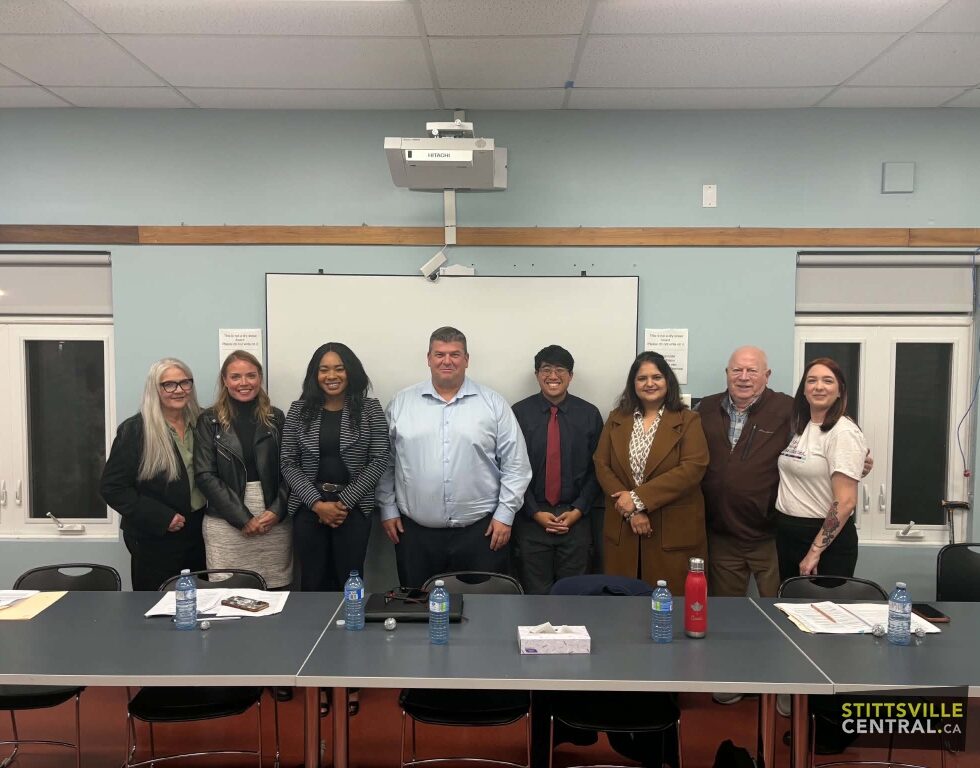
(West Side Pride hosted a two-hour equity and inclusion forum for Ward 6 candidates at the Stittsville Library on October 6, 2026. L-R: Marion Steele-Host, Chelsea Walton, Marie-Ange Ahinful, Paul Meek, Kevin Hua, Sheetal Narwal, John Eastwood-representing Theresa Qadri, and Kat Curnow-Host.)
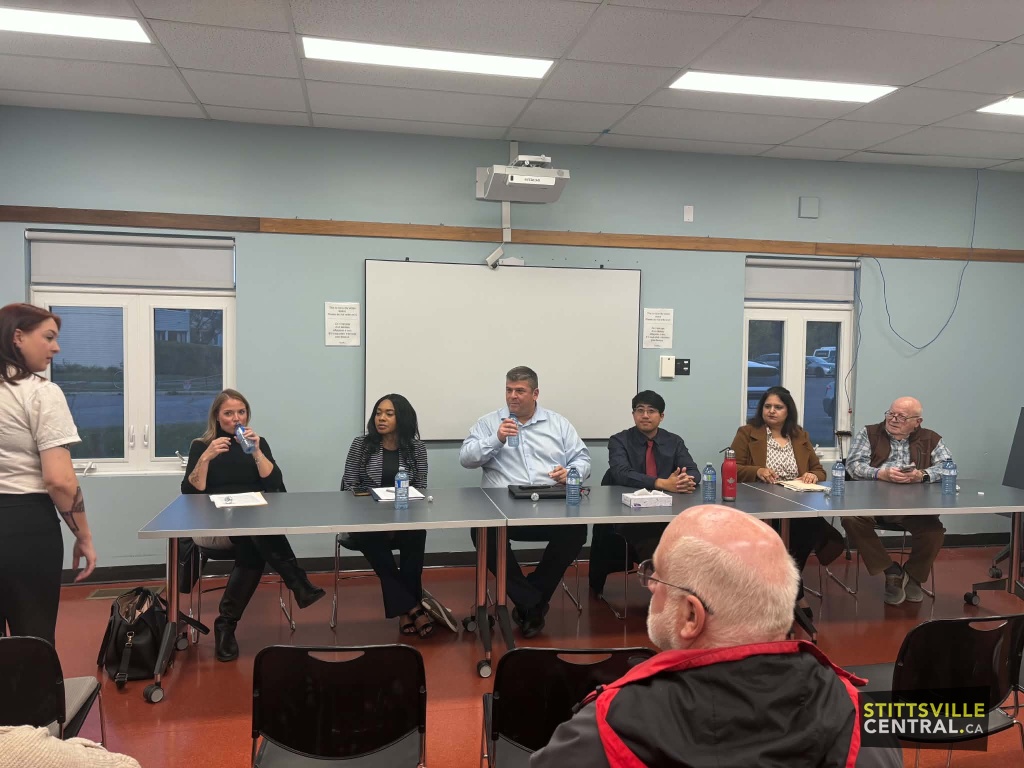
On Tuesday, October 6, 2026, West Side Pride hosted a two-hour equity and inclusion forum at the Stittsville Library, moderated by Marion Steele and Kat Curnow. Organizers said they arranged the event because other candidate forums had given these topics little attention.
Chelsea Walton, Marie-Ange Ahinful, Paul Meek, Kevin Hua and Sheetal Narwal participated, with John Eastwood presenting responses on behalf of Theresa Qadri. Written statements from Tanya Hein and Mani Sharma were also read. Over the evening, the questions connected municipal decisions to everyday concerns: finding a suitable home, reaching local services and feeling safe and welcome in the community. The discussion also considered the experiences of LGBTQ+ and other marginalized residents and their opportunities to help shape municipal decisions.
Local supports and housing for residents
Receiving help closer to home was a recurring concern. Candidates considered how Stittsville residents could access more support locally, and what it would take to remain in their community as their housing needs change.
Walton, Ahinful, Hua and Narwal supported bringing more services into Stittsville, with different ideas about where to begin. For Walton, the starting point was working with residents and community organizations to identify gaps in mental health, addiction and youth supports. Ahinful suggested inviting service organizations into libraries and recreation facilities, while making it easier for smaller organizations to obtain funding.
Hua and Narwal both suggested using existing spaces to bring more services into Stittsville. Hua wanted to use City-owned land and buildings to give providers room to operate. Narwal suggested testing satellite programs that would bring existing organizations into local facilities. “We can start with a pilot, a satellite program where we are not looking for new funding because we are already paying for it,” she said.
Meek favoured regional service locations across Ottawa. A western hub could serve Stittsville, Kanata and Bells Corners, even if it were not located in Stittsville itself. Narwal noted that bringing services to the west end would still leave a transportation question: residents would need dependable ways to reach them.
City-owned property was also part of the housing discussion. Walton identified the former Pretty Street Community Centre site at 2 Pretty Street as an opportunity to advance affordable housing, including accessible units. A City construction notice scheduled demolition of the vacant building to begin in late September to prepare the property for future nonprofit housing.
She also suggested exploring affordable housing above a renewed food bank and space for social programs at 1631 Stittsville Main Street. As a model, she pointed to Hollyer House in Bells Corners, which combines housing with community services.
To help nonprofit providers build, Hua proposed leasing City land, waiving fees and speeding up approvals. He also wanted a community benefits framework to work with developers on securing affordable and accessible housing. Ahinful supported partnerships with nonprofit and co-operative housing providers; co-operative housing is governed by its members.
Qadri’s budget response supported federal funding mechanisms such as the Housing Accelerator Fund, administered by the Canada Mortgage and Housing Corporation to help municipalities remove barriers to development and increase housing supply. Narwal emphasized the need to know how many proposed units would be affordable or accessible, and when residents could expect them.
For seniors, the discussion focused on being able to stay in familiar surroundings. Meek emphasized housing options that would allow people to age in place, remaining in their homes or community as their needs change. He also said housing should reflect the needs of smaller and multigenerational households. Ahinful wanted seniors to remain close to family, while Narwal proposed helping residents navigate permits for additional dwellings and monitoring how taxes and levies affect seniors.
The need for support close to home also shaped the answers on homelessness. Walton stressed that these needs extend beyond downtown. Hua supported Housing First, which prioritizes permanent housing alongside supports to help people remain housed, and expanding ANCHOR, the Alternate Neighbourhood Crisis Response. ANCHOR provides a community-led, non-police response to mental health and substance use crises. Its June 2026 expansion brought services eastward into neighbourhoods including the ByWard Market and Vanier, but did not include Stittsville.
Meek described homelessness as a shared responsibility across Ottawa, while Ahinful emphasized Stittsville’s priorities. Narwal called for realistic goals with measurable outcomes and timelines.
The proposals ranged from bringing existing services closer to residents to creating housing that would allow people to remain in their community as their needs change.
Removing barriers to getting around
Reaching a service can depend on more than where it is located. The transportation discussion covered the journey from a resident’s doorstep to a bus stop or appointment, including the barriers that snow and unreliable transit can create.
Walton and Meek agreed that sidewalk-clearing priorities should be separated from road-clearing priorities, allowing pedestrian access and accessibility needs to guide decisions. “But people can’t get around with the snow to access the bus or access the services,” Meek said. Ahinful emphasized the routes people use to reach schools, bus stops, medical appointments and local services.
Hua wanted pathways included in winter maintenance and proposed a Vision Zero action plan, a road-safety approach aimed at eliminating traffic deaths and serious injuries. He linked that approach to budget priorities and the political will needed to make walking safer and more accessible. Narwal argued that clearing bus stops and shelters should be treated as part of delivering transit. In her response, Qadri proposed asking public health to conduct an accessibility review to identify sidewalk barriers.
For residents who rely on Para Transpo, Walton and Hua identified same-day booking as a priority. OC Transpo’s published service guide already lists same-day trip requests, although neither candidate specified how their proposal would differ from the existing process. Hua also advocated 24-hour booking access and a larger fleet. Ahinful wanted to investigate cancellations, delays and lengthy waits, while Narwal emphasized maintaining reliable service.
Proposals for regular transit addressed reliability in different ways. Walton called for reporting on individual bus routes, and Hua proposed a Stittsville bus station. In his written statement, Sharma outlined a two-tier shuttle system: service approximately every 10 minutes between major local hubs, and direct connections from park-and-ride locations toward downtown, the University of Ottawa and Carleton University. Narwal emphasized that dependable buses are essential to reaching services.
Alongside municipal changes, Narwal and Qadri described ways neighbours could help one another through winter. Narwal wanted more residents to know about Snow Go Assist, which helps eligible low-income older adults and people with disabilities pay for snow removal from private driveways and walkways. The separate Snow Go program helps older adults and people with disabilities find someone to hire for snow clearing.
Narwal also proposed organizing volunteers through a local “Snow Angels” initiative to help seniors. Ottawa already has a Snow Angel program that recognizes residents who help neighbours clear snow. In her response, Qadri proposed a “Caring Community” initiative bringing neighbours together for snow removal, safety and friendship checks.
The discussion connected changes to municipal services with neighbourhood assistance, addressing barriers both at residents’ doorsteps and along the routes they use.
Making public spaces safe and welcoming
Being able to use a park or attend a community event was discussed in terms of both physical access and a sense of belonging. Candidates considered how the councillor’s visibility, public-space design and responses to discrimination could help residents feel welcome.
Continuing Pride events and flag raisings was part of Walton’s and Hua’s approach. Hua said he would oppose a motion to stop flying the Pride flag. “It means so much to me as a person to see them here, to see all the community come together around that,” he said of community events and representation.
Meek emphasized that the councillor should lead by example, encourage learning about different cultures and make clear that negative attitudes toward those communities would not be welcome under his leadership. Both he and Hua described community gatherings as opportunities to build understanding, while Ahinful committed to speaking out against discrimination and helping organizations obtain event permits.
An audience question brought education into the discussion of safety. Walton acknowledged some communities’ distrust of police while supporting collaboration based on residents’ needs. Ahinful emphasized that police presence does not make everyone feel safe and called for education through schools and community organizations.
Meek also recognized that residents have different views about police presence and emphasized community relationships. Hua favoured considering community responses before defaulting to police, citing ANCHOR. Narwal supported documenting harassment and involving police when responding to hate.
Narwal also supported Ottawa’s Safe Access By-law, commonly called the “bubble” bylaw, which took effect on August 1, 2026. Eligible facility owners and operators can apply for zones extending 50 metres from access points onto municipal public land. Places of worship, schools, child-care centres, healthcare facilities and residential care facilities are eligible. The bylaw prohibits demonstrations within designated zones, subject to its exemptions, and also prohibits blocking access.
On the design of public spaces, Ahinful proposed better lighting, accessible pathways and washrooms. Walton wanted park designs to reflect residents’ interests. Narwal emphasized bringing community members, including queer youth and faith leaders, into the discussion before decisions are made. Qadri’s response supported reviewing policies and identifying deficiencies.
The answers reflected different approaches to safety, combining physical accessibility, community connections and responses to discrimination.
Turning community input into action
Across these issues, candidates returned to the question of who gets heard and what happens after residents share their views. Their answers addressed how to reach people whose voices are often missing, and how to show whether that input changes decisions or spending.
Walton and Narwal criticized consultation that has little influence on decisions. “I want to bring consultation back to the people, make it plain language,” Walton said. She wanted it to begin earlier and take place through pop-up consultations in everyday community settings. Narwal emphasized access in English and French, translation support and involving diverse groups before decisions are made.
Building ongoing relationships was another part of the discussion. Hua called for direct engagement with communities facing systemic barriers or unequal access. Meek proposed working with community leaders to identify unmet needs.
Walton and Narwal wanted residents to see what changed because they participated. Narwal also called for explanations when requested changes could not be made. Hua proposed public reporting on how departments applied an equity lens, examining who benefits, who faces barriers and how decisions could improve fair access. Qadri suggested concrete indicators, including the proportion of Stittsville capital projects meeting or exceeding accessibility standards.
Candidates also differed on how to fund those priorities. “And I believe if something is priority, we need to put money behind it,” Ahinful said. She also called for questions about who benefits or is excluded. Narwal wanted results measured and efficiencies found before seeking additional spending. Meek proposed learning from spending that had failed to meet community needs. Qadri supported purchasing from diverse and social-purpose suppliers, including businesses from underrepresented groups and organizations advancing social goals.
Representation within the councillor’s office mattered to Walton, who proposed diverse staffing and ongoing relationships with underrepresented groups. Ahinful emphasized voices missing at City Hall, including francophone and racialized communities. Hua highlighted how lived experience can help identify barriers. Hein’s written statement called for an equity lens across all council actions and diverse participation in decisions.
The councillor’s public platform was also discussed as a way to connect residents and support local businesses. Walton wanted local-business promotion to reflect Stittsville’s diversity, and Hua emphasized seeking out businesses with less visibility. Meek proposed regular videos highlighting businesses and events. Hua also suggested a database connecting organizations seeking volunteers with residents looking for opportunities.
Across the evening’s discussion, equity and inclusion were connected to practical concerns: whether residents can remain in their community, reach the services they need, use public spaces safely and have a meaningful say in decisions affecting them. By bringing those concerns together, the forum gave residents a fuller picture of how candidates would approach the work of making Stittsville a place where more people can participate and feel they belong.