








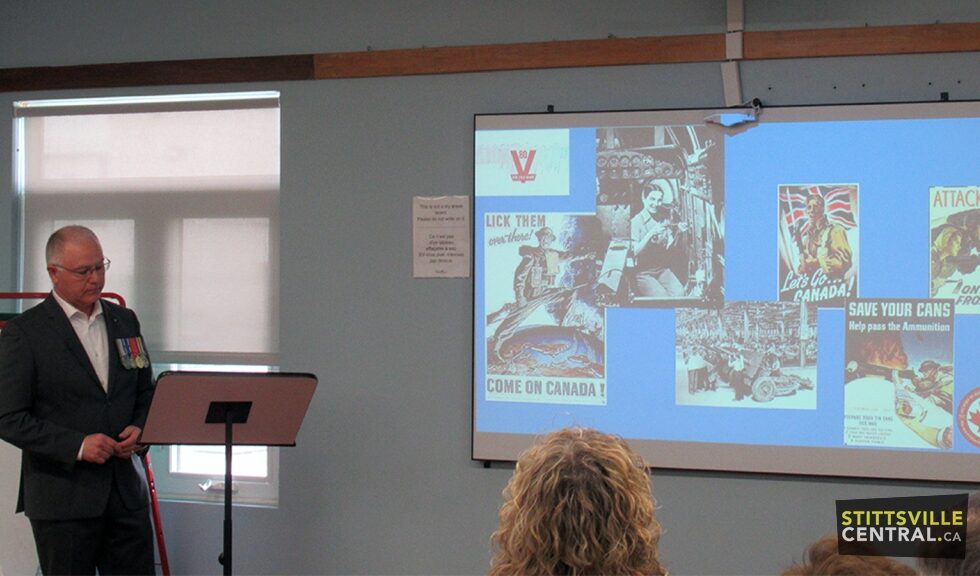
May 8, 2025 marked the 80th anniversary of VE Day, or Victory in Europe Day, when Nazi Germany surrendered to the Allied forces, effectively ending World War II in Europe. This day was a time of immense joy and celebration, with spontaneous festivities erupting across Britain. While the war in the East continued, Germany’s capitulation was a pivotal moment, signifying the end of the European theater of conflict.
On May 24th, Michael Ostafichuk CD (Ret’d), current President of the Stittsville Royal Canadian Legion, Branch 618, was the guest speaker at the Goulbourn Township Historical Society’s monthly event. He presented the many events that took place during the WWII to a full room of interested attendees through his words and a slide show. After his presentation, many attendees posed questions and shared memories.
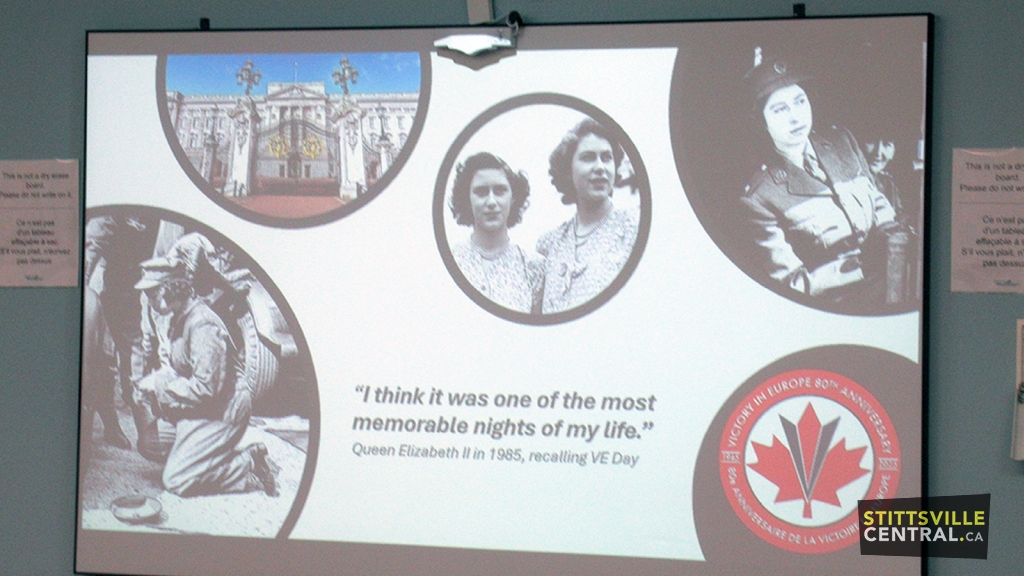
The surrender and the explosion of hope for a better life was celebrated with parades in London and Paris and towns across Europe while even the leaders of erstwhile mortal enemies were bonding again. Germany itself expressed gratitude for the change that May 8, 1945 brought — to the world and to itself. Germany was one of the few countries that did not recently celebrate the 80th year VE Day celebration.
Across Canada after learning of the surrender many newspapers had special sections dedicated to the war effort and VE Day. “Our army shares in great victory,” read one headline, noting that “Canadians played a leading part in the toughest battles of the European war.” The supplements also shared full pages describing how pilots “found their wings over the rolling Prairie” while training with the British Commonwealth Air Training Plan from December 1939 to early 1945. These battles occurred in the hot, blistering sun of Sicily and Italy and the rain, cold and mud of France, Belgium, Holland and Germany.
Some major battles that were inclusive of Canadian soldiers included Dieppe in August 1942, Sicily in July 1943, the Italian campaign from September 1943 to January 1945, Ortona, Italy in December 1943, the D-Day invasion in June 1944, the Battle of Normandy from June to August 1944, campaigns in the Netherlands from late 1944 to early 1945, and northern Germany in spring 1945.
The British Commonwealth Air Training Plan turned out more than 131,000 airmen from Canada, New Zealand, Australia, South Africa, Poland and elsewhere, while it led U.S. President Franklin D. Roosevelt to dub Canada the “aerodrome of democracy.”
Many of the soldiers coped with the seriousness of the war by maintaining a sense of humor and finding joy where they could, but it didn’t mean ignoring the brutality around oneself.
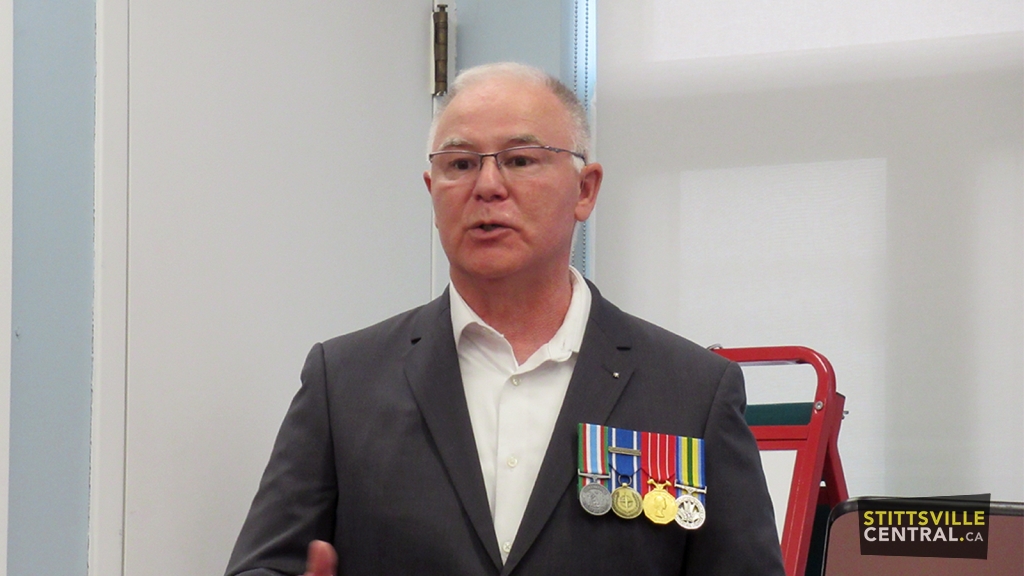
Along with a long career in the Federal Government Michael Ostafichuk joined the Canadian Armed Forces Primary Reserves in 1985. He also serves on the Soldiers’ Aid Commission as a commissioner.