









As we brave the cold and move into the second month of the new year, February is sure to act as a very busy month for astronomy lovers worldwide. From a secretive annular solar eclipse to one of the biggest spaceflight missions of the decade, here are some of February’s most anticipated astronomical events.
The full moon of the month, more commonly known as the Snow Moon, will be reaching its peak illumination at 5:09 PM (Eastern Time) on February 1. The fitting name for this moon comes from the amount of snowfall that takes place throughout February, while some alternate titles for it include the Bald Eagle Moon, the Goose Moon, and the Groundhog Moon. This Snow Moon will not be a supermoon, unlike the past four consecutive full moons of October, November, December, and January; but it promises to be a great start to this month in astronomy nonetheless.
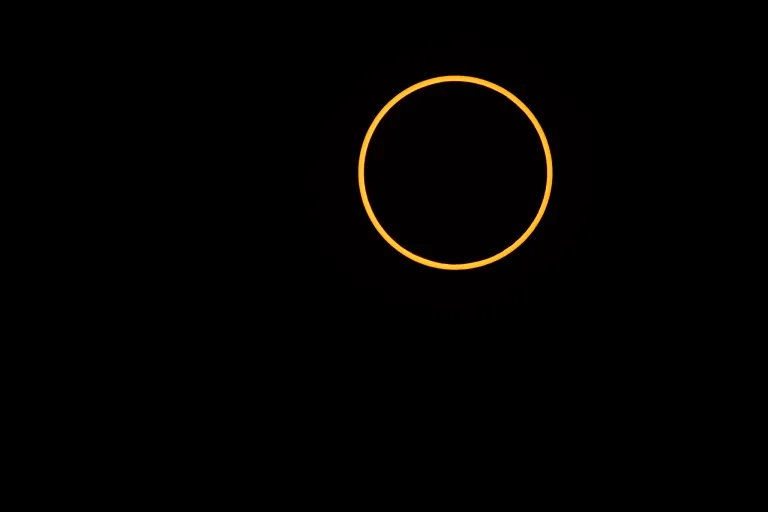
On February 17, a very limited region of the planet will be able to experience an annular solar eclipse. Annular solar eclipses occur when the Moon passes between the Sun and the Earth at a time when it is not near its farthest point from our planet. Because of this, its disk does not completely cover the Sun, creating a sort of “ring” around it. Annular solar eclipses are slightly more common than total solar eclipses, making up approximately 30% of all solar eclipses, and can be seen every one to three years from certain locations on Earth. However, the full extent of this specific eclipse will only be visible over remote regions in Antarctica, with some partial visibility possible in parts of South America and Africa. During this particular eclipse, 96% of the Sun will be covered at its furthest point (or its “annularity”), a sight that will last for a little over two minutes.
Finally, the highly anticipated Artemis II lunar spaceflight mission has an estimated launch window scheduled for a date between February 6 and February 15. After originally targeting a 2023 launch and spending years undergoing technological delays, this 10-day crewed spaceflight mission will mark humanity’s first return back to the Moon since the final Apollo mission over five decades ago. Though this specific mission will not see the crew physically stepping foot on the Moon (a task belonging to Artemis III, the third phase of the mission), the mission’s Orion spacecraft will carry them beyond the far side of the Moon to a distance of over 400,000 kilometres from Earth, potentially breaking the human spaceflight distance record set by Apollo 13 in 1970 and testing the capabilities of the spacecraft for future phases. The spacecraft will be launched by the Space Launch System – NASA’s most powerful rocket ever – from Florida’s Kennedy Space Center.
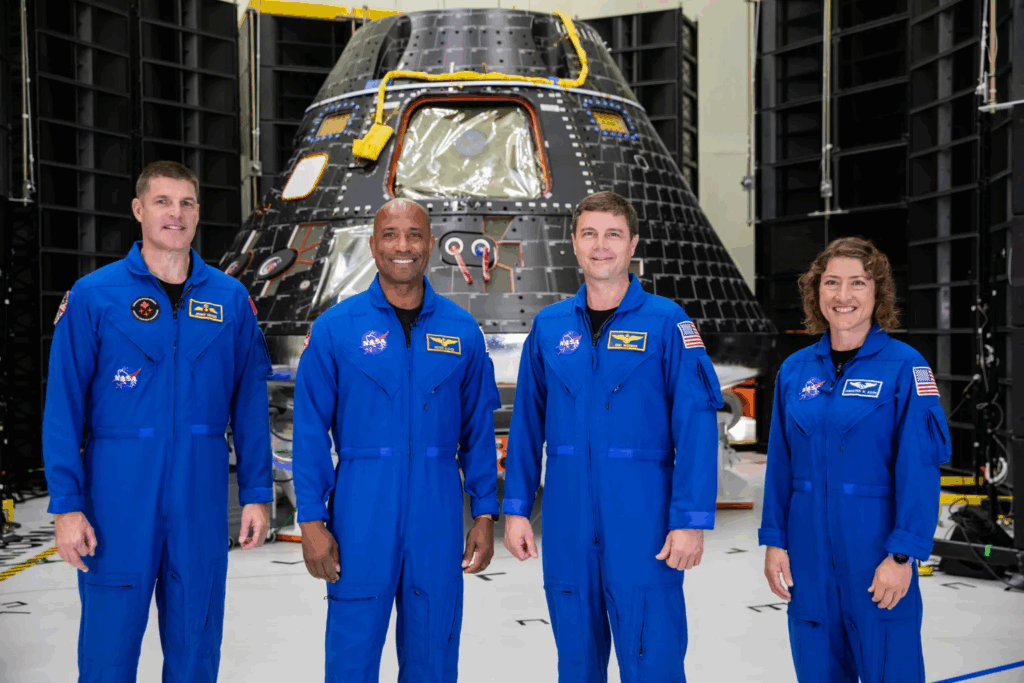
The four-person Artemis II crew includes commander Reid Wiseman, American astronaut and engineer with a little over 165 days logged in space to date; pilot Victor Glover, United States Navy captain and astronaut who is set to become the first person of colour to fly beyond low-Earth orbit on this mission; mission specialist Christina Koch, an engineer who currently holds the record for longest continuous time in space by a woman and who will also become the first woman to fly beyond low-Earth orbit through Artemis II, and mission specialist Jeremy Hansen, Canadian physicist and fighter pilot with no previous spaceflight time who will become the first non-American astronaut to pass low-Earth orbit and, potentially, the first to actually step foot on the Moon.
Overall, this month will certainly contain both interesting and record-breaking events in the world of astronomy. Whether you choose to stay up and watch the launch of the Artemis II mission or would rather take a look at the Snow Moon, the second month of 2026 will certainly have plenty of astronomy opportunities for everyone. Good luck, and happy observing!