









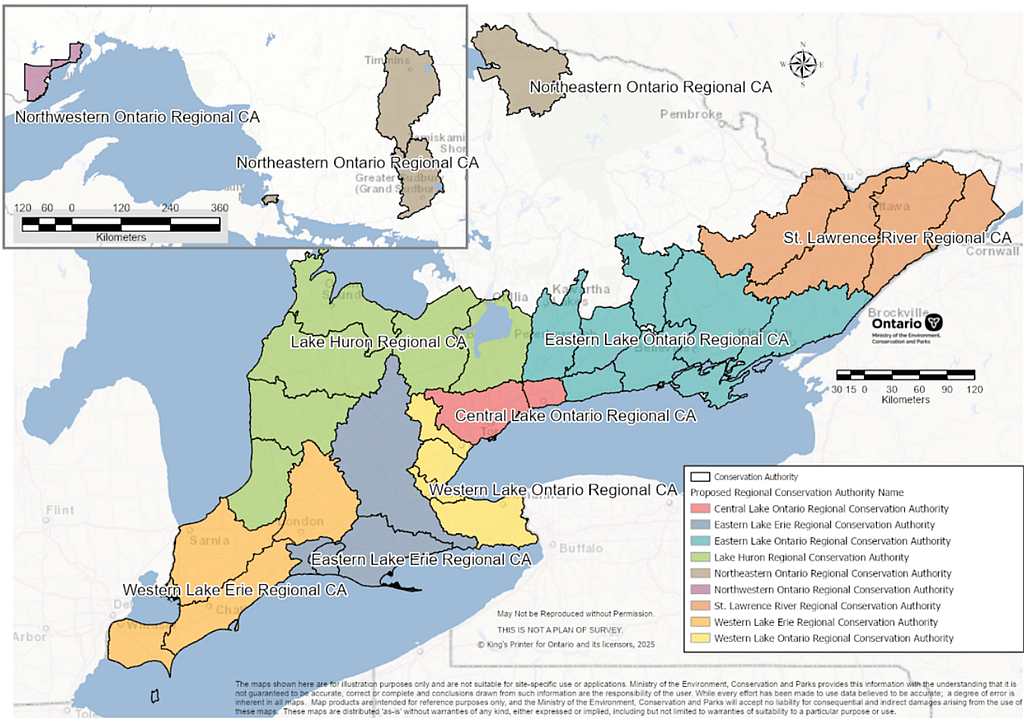
Conservation authorities are responsible for issuing permits for various types of infrastructure development and housing in floodplains, shorelines and wetlands. The government’s latest announcement on March 10, 2026, stated that the existing 36 individual conservation authorities would be consolidated into nine regional conservation authorities, rather than the seven previously announced, all of which will be overseen by a newly created provincial agency – the Ontario Provincial Conservation Agency (OPCA) through Bill 68, Plan to Protect Ontario Act (Budget Measures), 2025 (No. 2).
The province believes this new model will better strengthen informed choices for conservation authorities “to support the building of new homes and infrastructure” while continuing to protect communities from flooding and other natural hazards, according to its March news release.
In our region, the Province proposes to amalgamate four Conservation Authorities (Mississippi Valley CA, Rideau Valley CA, Raisin CA and the South Nation CA) to form the St. Lawrence Regional Conservation Authority, having removed the Cataraqui River Conservation Authority from the original plan.
Sally McIntyre, General Manager of the Mississippi Valley Conservation Authority told us, “the St. Lawrence River Regional Conservation Authority will have four conservation authorities instead of the originally proposed five, with Cataraqui River Conservation Authority no longer part of the eastern Ontario amalgamated region. Board members will be appointed by the City and area counties, and it is unclear how many seats the City will have with indications it may be limited to five. MVCA’s jurisdiction is over 4,000 square kilometres, which would make it difficult to manage from a single centralized office and why we feel local offices should be maintained.”
“The province is to appoint a Project Executive to oversee development of the Transition Plan and to act as CAO of the new Region for up to 2 years. The government has committed to providing $3 million in year one to cover amalgamation costs across the province. If amalgamation outcomes expected by February 1 are too ambitious, there is potential that the processing of permits and planning applications could be impacted.”
The government initiated public consultations under ERO 025-1257 that took place between November 7 and December 22, 2025 on the original seven proposed boundaries for the regional conservation authorities. While originally seven regional authorities were proposed, the provincial government announced that it will now proceed with nine “to accommodate areas with distinct geographies and development contexts, better balance differing priorities across rural, urban and northern areas and improve alignment with watersheds and with source protection regions.”
Janet Stavinga, Chair, Friends of Stittsville Wetlands; former member of Chair of the Mississippi-Valley Source Protection Committee; Vice-Chair, Rideau Valley CA; and former Mayor of Goulbourn Township and an Ottawa City Councillor, has been working with a group of 74 retired professionals across Ontario who have dedicated decades of service to local science-based and integrated water resource management through their efforts with Conservation Authorities (CAs) across Ontario. In December, 2025, as a collective, they submitted a letter to the Premier and Ministers urging the Government of Ontario to proceed with care and caution in the proposed consolidation of Conservation Authorities. A copy of their letter can be found here. Their collective submission offered 16 recommendations in the spirit of collaboration and enhancement of client service, watershed management, and natural hazard management in Ontario. In Janet’s capacity with the Friends of Stittsville Wetlands, they also signed on to Ontario Nature’s submission to the province with 93 other organizations. The submission can be found here.
Janet says, “Our Premier and his government have the opportunity to develop a collaborative relationship with municipalities and re-empower conservation authorities. This alternative path can then ensure that future decisions honour the legacy established by Premiers George Drew, Leslie Frost, John Robarts and William Davis. These decision makers demonstrated foresight in enabling the formation of CAs through strong municipal-provincial partnerships to address natural resource challenges affecting economic growth and development by promoting restorative conservation initiatives for the people of Ontario. This is their legacy. What will be the legacy of Premier Ford?”
The Association of Municipalities of Ontario (AMO) wrote on their website: Implementation of these reforms entails significant risks for municipalities around the transition, budgeting, governance, funding, and public communications. AMO calls on the province to work collaboratively and transparently with municipalities, conservation authorities, developers, and Indigenous representatives to address these risks. **The AMO will comment on the proposed legislative changes once they are tabled in the spring session.
Phil Sweetnam, who has represented Ottawa on the Mississippi Valley Conservation Authority Board for 41 years, says, “I recognize that Conservation Authorities (CAs) will make every effort to adapt to the proposed restructuring and to ensure that the new system functions as effectively as possible.”
However, he has offered his observations:
1. Organizational Size and Cost Savings – The government should be aware that creating larger organizations does not necessarily result in cost savings. Past amalgamations in the Ottawa area demonstrate that consolidation often fails to reduce costs and can, in some cases, increase administrative complexity.
2. Duplication of Responsibilities – The government has indicated that restructuring will eliminate duplication. However, in my experience both as a board member and as an applicant for permits, duplication rarely occurs within the Conservation Authorities themselves. Where duplication does occur is often between municipalities and CAs.
3. Permit Processing Timelines
One of the expectations associated with restructuring is that it will accelerate the permit approval process. However, I understand that in 2025 approximately 97% of CA permits were issued within provincially mandated timelines. Given this strong performance, it is unclear that centralizing applications within larger organizations would result in further improvements.
4. Provincial Responsibility for Water Management
Water management is constitutionally a provincial responsibility. Yet, in practice, only about 4% of CA funding—approximately $2.7 million—comes from federal and provincial sources. While the province does contribute to certain initiatives, such as dam restoration, municipalities continue to bear much of the financial burden.
5. Provincial Oversight and Funding
Under the proposed restructuring, each of the nine new Conservation Authorities will have a provincially appointed overseer. If the province believes that such oversight is necessary, it would be reasonable for the province to fund these positions rather than requiring municipalities to absorb the additional costs through increased levies.
In conclusion, Phil states, “In summary, while I hope that the new structure will lead to some of the improvements envisioned by the province, it is important that the implications for costs, governance, and operational efficiency be carefully considered.
Councillor Gower has shared his concerns and comments with us as well. “On Tuesday, the provincial government announced revised plans to consolidate the 36 CAs down to nine (instead of seven), along with other changes to what was originally proposed in the fall. They’re targeting February 2027 to complete the mergers. A few other things that stood out to me in the update:
- The governance still isn’t clear to me. The province says the CAs will remain independent organizations – presumably this means independent from the province, even though they sit under a new Ontario Provincial Conservation Agency. It’s not clear how this governance would function. And provincial officials emphasized that the new CAs will maintain municipal governance. But only cities and counties will have representation on the management boards. Lower tier municipalities (towns and townships) will be cut out. And a single board will now be managing an organization responsible for a much larger geography.
- CAs will still continue to manage land that they own, including conservation areas.
- The CAs will establish new “watershed councils” to “help identify local priorities for watershed-based conservation programs and services”.
- I’m not a fan of the name they’ve assigned to the Ottawa region CA – “St. Lawrence River Regional CA”. It’s a bit of a misnomer, given that most of the watershed rivers flow to the Ottawa River: Mississippi, Carp, Rideau, and South Nation. Only the Raisin River flows directly into the St. Lawrence. (Although I suppose the Ottawa eventually drains into the St. Lawrence?)
We reached out to Carleton MPP, George Darouze to ask for his thoughts on the proposed changes to be implemented. The following was provided: “Ontario currently has 36 conservation authorities, each with different permitting processes, timelines and resources. This can create confusion and duplication in service in Ottawa and across the province.
“A shift to nine regional conservation authorities will help reduce duplication and direct more resources to frontline work. To be clear, the new regional conservation authorities will continue to deliver on the same mandate and provide the same programs and services that they deliver today, while remaining municipally governed and keeping their local offices and staff.
“The newly formed local watershed councils will also ensure that the voices of municipal leaders, Indigenous communities and local experts remain a part of watershed planning. To support this change, our government is adding an additional $3 million annually for the Ontario Provincial Conservation Agency to deliver a smooth transition.
“Steps are expected to be taken in the coming weeks to target full implementation in early 2027.”
These regressive changes to consolidate the 36 conservation authorities into just nine, overseen by a new centralized provincial agency, has certainly raised concerns of local environmental groups and the public. A shared concern being that the changes would create limitations to a CA’s mandate, resourcing and independence. These changes could also create conditions under which it is far more likely that the critical local knowledge will be excluded from key decisions, leaving communities more exposed to flooding and other environmental harms.