








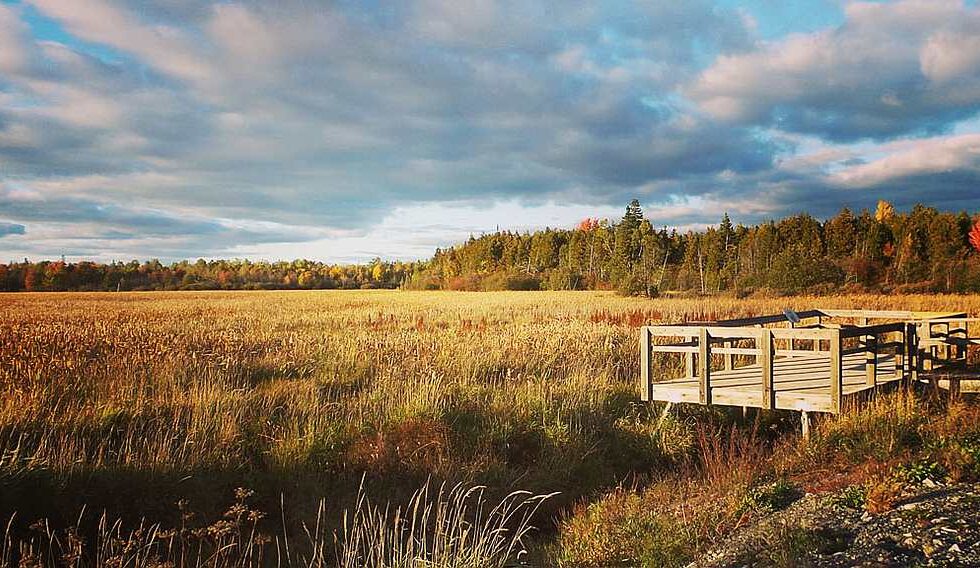
(The lookout deck found along the Trans Canada Trail at the Goulbourn Wetlands Complex. Photo: Stittsville Central)
With an environmentally rich community like Stittsville, it’s important we take the steps to protect it. It might feel harder than ever to be environmentally conscious these days, but here are five things you can do regularly to make a difference.
1. Shop second-hand
Don’t let things waste away in a landfill. Thrift stores or neighbours, there are items with a history just waiting to be given a new home. Buying second-hand is a great way to extend a products life and reduce the number of items that end up in our landfills. It also helps reduce the demand for new products which cuts back on production/textile waste. Plus, buying second-hand saves on extra packaging!
A few second-hand stores in Stittsville:
- Habitat for Humanity Greater Ottawa ReStore: 3 Iber Rd
- Re-Read Used Books: 1626 Stittsville Main St
- Stittsville’s Vintage Market: 2079 Carp Rd
- Value Village: 5487 Hazeldean Rd
2. Support local businesses
A community like Stittsville is booming with local businesses you don’t want to miss out on. Supporting local is great for building a local economy and bonding with your community, but it also has great environmental impacts. Shopping local reduces your carbon footprint when the products are sourced closer to you. Since it doesn’t have to travel as far, it lowers CO2 emissions. When you buy from local farmers, you’re also helping the conservation of land by supporting their farmland.
Book lover? Borrowing is better than buying! Using the library is a great way to support an author without driving up production needs. The Stittsville Ottawa Public Library branch is located at 1637 Stittsville Main.
Check out local Stittsville businesses on the Stittsville Local Business Directory
3. Avoid generative AI
Generative artificial intelligence (AI) has been a growing industry over the last few years, but did you know about its harsh environmental impacts? Generative AI uses massive amounts electricity, energy, and freshwater. A single query to a learning language model such as ChatGPT uses at least five times the amount of energy a regular google search does. The data centers that power generative AI depend on massive amounts of water to stop the computers from overheating, but the toxins from the centers pollutes the water, making it unusable after. The water tends to come from the municipality the data center is based in, draining the local supply and disrupting ecosystems. Our water isn’t infinite, and people living near data centres are already having shortages. Not using generative AI is a great way to reduce harm to the environment.
4. Recycle and compost
We all know recycling and composting helps reduce waste, but it’s important to make sure it’s done properly to actually be effective. Here are some recycling and composting tips:
- Rinse and dry your plastic and metal before recycling to avoid contamination.
- Break down your boxes to make more space and easier processing.
- Separate caps from bottles for easier sorting.
- Plastic bags cause jams in recycling centres, so remember to not bag your recycling.
- Always check if you’re unsure if something should be recycled or composted to avoid contaminating other materials.
Why recycle? Our paper, cardboard, glass, metals, and plastics are sorted, cleaned and turned into raw materials for manufacturing. This gives items a second life and reduces the waste in our landfills.
Why compost? When food scraps and yard waste decompose they can be turned into nutrient rich fertilizer. This process reduces greenhouse gas emissions and uses less water and synthetics because of it’s organic nature.
Not sure what goes where? Use the City of Ottawa’s Waste Explorer tool to determine which bin your waste should be in. Reminder: On March 30th the City of Ottawa is updating the garbage collection schedule. You can check if your location is impacted by visiting Your garbage and recycling collection calendar – Recycling | City of Ottawa.
5. Use public transit
Owning a vehicle can save you large amounts of time when commuting in and out of Stittsville, but it’s important to think about the impact we have every time we drive. Our vehicles are one of the biggest contributors to air pollution, and choosing to take public transit cuts back our personal carbon footprints. If you have time to spare, taking transit is a much more environmentally friendly method of travelling. Even if you can’t do it everyday, every trip counts.
Never forget, the best way to make an impact is to take action. Participate in cleanups, educate those around you, and look towards those advocating for a greener world. Sometimes it can feel like anything you do won’t make a dent in helping protect the environment. But at the end of the day, every small act helps create a better world.