









This month is not the most active when it comes to the night sky, with many of the notable events occurring in the first week. Nevertheless, there is still plenty to be observed. Here are some of May’s most anticipated astronomical phenomena and rocket launches.
May 2023 begins with a full moon most commonly known as the Flower Moon, though it is also called the Budding Moon, the Leaf Budding Moon, and the Planting Moon. It will be bright and visible on the nights of May 4 and May 5, though peak illumination will occur while the moon is under the horizon at 1:36 PM (Eastern Time) on May 5.
Also taking place on May 5 is a penumbral lunar eclipse. This is the first of two lunar eclipses that will occur in 2023, with the second happening in late October. This eclipse will be seen rising over Africa and parts of Europe, and will be fully visible in Australia and Asia.
The predicted peak of the Eta Aquarids meteor shower is taking place on May 6, though the shower itself has been active since April 15, and will continue to be until May 27. Anywhere from 10 to 30 meteors per hour can be expected, though rates vary based on location. Unlike many other meteor showers, the Eta Aquarids are most commonly visible near morning rather than late at night. They are most likely to be seen before dawn in regions with little to no city light, though the full moon could make it difficult for them to be visible at all. The comet of origin for the Eta Aquarids is Halley’s Comet, which is commonly considered the most famous comet of all time. Halley’s Comet has been sighted for millennia, most recently in 1986, and will not return to our skies until 2061.

(An image of Halley’s Comet during its most recent flyby in 1986. Photo credit: NASA/National Space Science Data Center)
Axiom 2, the second privately funded mission to the International Space Station, will be launched from a Spacex Falcon 9 rocket on May 8. The crew consists of Commander Peggy Whitson, a former NASA astronaut who has logged more time in space than any other American astronaut; Pilot John Shoffner, a racing driver and investor with over 8500 flight hours logged; Mission Specialist Rayyanah Barnawi, a biomedical researcher who is set to become the first female Saudi astronaut during this mission; and Ali Alqarni, an Air Force Captain and fighter pilot with a bachelor’s degree in Aerospace Science. Over 20 experiments will be conducted by this crew while they are onboard the station.
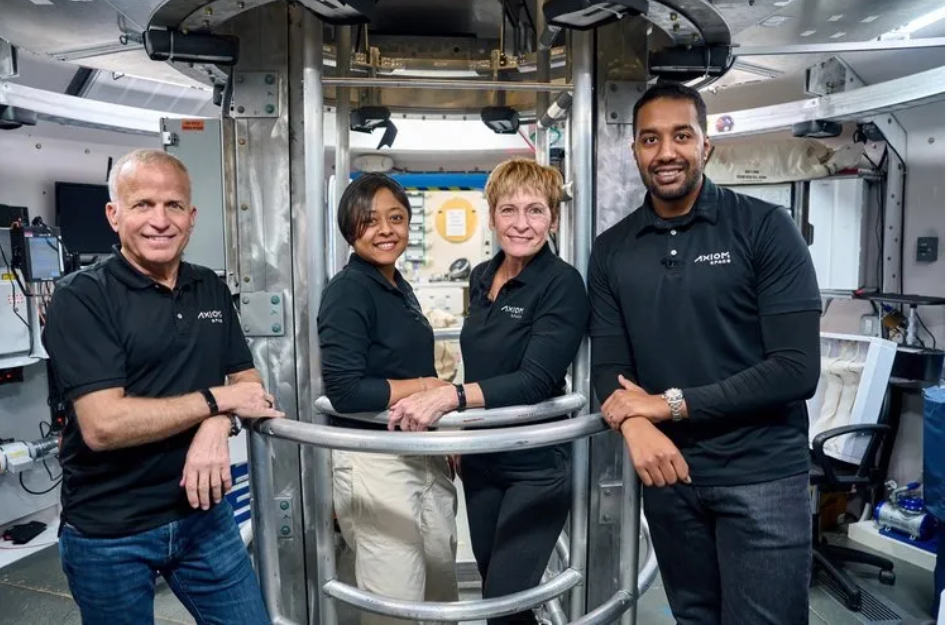
(The crew of the privately funded Axiom 2 mission to the International Space Station. From left to right: Pilot John Shoffner, Mission Specialist Rayyanah Barnawi, Commander Peggy Whitson, and Mission Specialist Ali Alqarn. Photo credit: Axiom Space)
Mercury will reach its greatest western elongation at 2:00 AM (Eastern Time) on May 29. “Elongation” refers to the apparent distance between a celestial body and the Sun as viewed from Earth. When greatest elongation occurs, a planet will appear to be at its farthest distance from the Sun, meaning that it will be more easily visible in the sky at that time and for the next few days. When a planet is at its greatest eastern elongation, visibility will be increased in the evening, while greatest western elongation indicates heightened visibility in the hours approaching dawn.

(An image of Mercury taken by the Messenger probe at a distance of 27,000km from the planet. It was taken on January 14, 2008. Image credits: NASA/Johns Hopkins University Applied Physics Laboratory/ Carnegie Institution of Washington)
Each of these events provides a chance to experience an astronomical event firsthand. Whether you choose to support the Axiom 2 crew on their historic launch or would rather observe Mercury later on in the month, May is full of opportunities for every one of us to learn more about our night sky.