








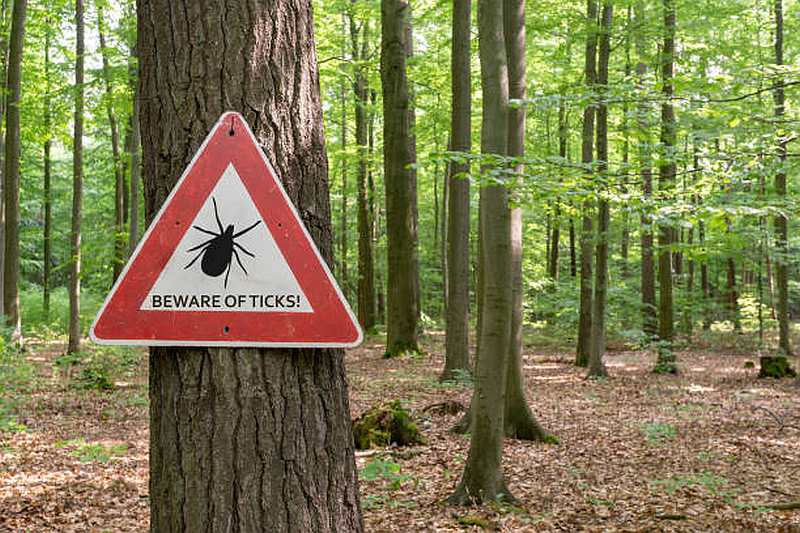
The 2026 tick season is expected to be bad due to a warming climate and the heavy snow cover received in the Ottawa area. Black legged ticks (also known as deer ticks or by the scientific name Ixodes scapularis) have increased in numbers in our part of the country and continue to do so. The percentage of ticks carrying Lyme disease has increased, even with the actual number of ticks decreasing in the Ottawa area.
According to Ottawa Public Health, to date in 2026, there have been 29 confirmed or probable cases in Ottawa. With the increase in the number of cases reported in the Ottawa area in the last few years, Ottawa Public Health regularly conducts tick dragging to monitor tick populations and to test for Lyme disease.

But don’t let this information keep you or your pets housebound. You can take many precautions to avoid tick bites when enjoying nature. If you are in a forested or grassy area —
- stay on the path
- wear light coloured clothing that includes a long-sleeved shirt and long pants
- wear socks on your walks and tuck your pants into the socks
- use bug spray with picaridin or DEET
- roll a sticky lint roller over your clothes (and pet as well) before entering the house
- especially important is to do a tick check of your entire body, including in your armpits, groin area, behind your ears and along hairlines where they like to hide
- check out your pet’s neckline, legs, tail, stomach and chest area

If you do find a tick attached, remove it as soon as possible. Contact your doctor if the tick looks engorged or you think has been attached for a long time, to see if you need antibiotics. Some symptoms to watch for are fever, chills, head-ache, almost flu-like symptoms that are often associated with a red target or bulls-eye shaped rash. At times, you may see a tick on your body and not realize it as they can look similar to skin tags.

Lyme disease, and other diseases such as Hantavirus, is carried by the white-footed mouse (or deer mouse). That is, in fact, how ticks get infected. The tiny larva of ticks need to feed on an infected mouse. They then turn to the next phase that is called a nymph (being the size of a poppy seed). It is the nymph that can pass the Lyme disease onto to humans.
Entomologists have indicated that with the milder winters being experienced over the past decade, this allows the ticks to survive the season and they are moving further eastward.
Stittsville is currently included in the high-risk area for ticks and Lyme disease. It is strongly recommended that you (and your pets) take every precaution to avoid ticks and the possibility of contracting Lyme disease.
The UPTick Project is a major multi-year research initiative in our area since 2020. It is led by Dr. Manisha Kulkarni at the University of Ottawa’s INSIGHT Lab. UPTick is a six-year study (Phase I 2019-23 and Phase II 2023-26) to enhance the understanding of how urban landscapes affect human risk from Lyme and other tick-borne diseases. The project conducts surveillance for tick-borne pathogens in ticks and small mammals at sites that represent different stages of urban development and connection to greenspace across the study areas.
Dr. Kulkarni says if you find a tick, you can take a photo, go to the online platform etick.ca and submit the photo.
The Stittsville community was included in Phase I of the project. The team continues their project on ticks and Lyme disease with the aim of assessing the impact of urban change on tick populations and tick-borne disease transmission. Phase II of the study is taking place across five Ottawa neighbourhoods: including Carp, Kanata North, Stonehaven, Findlay Creek and Blackburn Hamlet.